


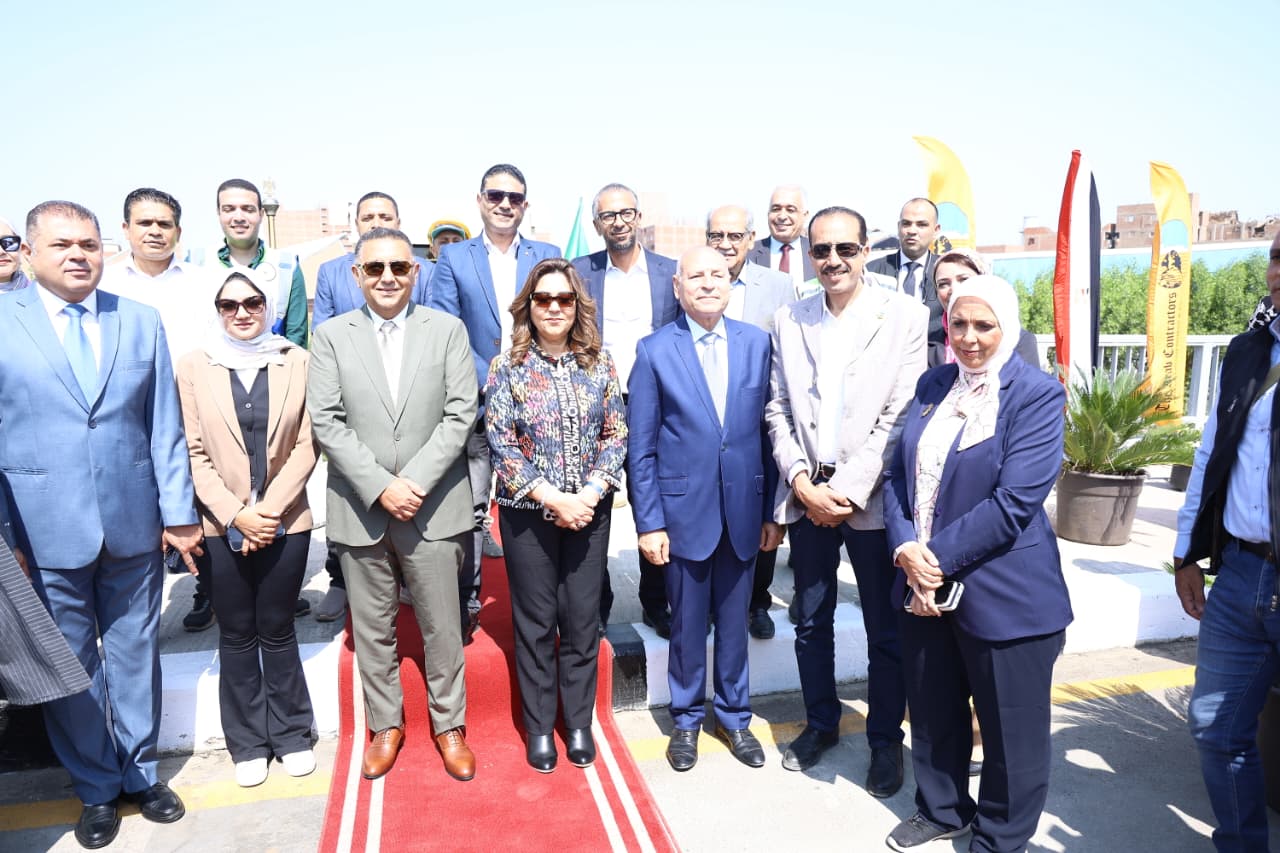
Minister of Local Development and Environment Dr. Manal Awad, Qalyubia Governor Dr. Hossam Abdel Fattah, and Cairo Governor Dr. Ibrahim Saber inaugurated the development and upgrading project of Amireya Bridge over the Ismailia Canal. The inauguration coincided with Qalyubia Governorate’s National Day celebrations and reflects the ongoing cooperation and coordination between Cairo and Qalyubia Governorates to implement joint projects and enhance the efficiency of strategically important transport arteries.
The inauguration ceremony was attended by Dr. Iman, Deputy Qalyubia Governor; Mr. Omar Mahmoud El‑Shafae, Deputy Cairo Governor; Eng. Jihan Massoud, Secretary‑General of Qalyubia Governorate; Dr. Mohammad Aql, Assistant Secretary‑General of Qalyubia; Dr. Salwa Abu El‑Aneen, Acting Head of Shubra El‑Kheima City; Mr. Yasser Ibrahim, Chief of East Shubra El‑Kheima District; members of the House of Representatives and the Senate; as well as executive officials and representatives of executing and consulting bodies.
Minister Manal Awad stated that the project reflects the state’s vision to preserve the efficiency and sustainability of infrastructure and to upgrade the road and bridge network as a key pillar for supporting development and improving citizens’ quality of life. She explained that the importance of the project lies not only in the bridge’s location and traffic volume but also in its role as a shared axis serving a wide geographic area between Cairo and Qalyubia, highlighting the value of inter‑governorate integration in planning and executing projects with direct impact on citizens’ mobility.
Awad added that the development works focused on rehabilitating structural elements and enhancing the bridge’s technical efficiency to extend its lifespan and strengthen safety standards. The ministry, she stressed, continues to support governorates in maintaining existing assets and maximizing the use of public investments.
Governor Hossam Abdel Fattah said that the Amireya Bridge project is one of the important initiatives aimed at upgrading main corridors and serving citizens. He noted that the bridge is a vital traffic artery linking Qalyubia with Cairo and accommodating heavy daily movement. He explained that the project is part of the governorate’s approach to improving infrastructure efficiency and optimizing existing projects, with works including structural rehabilitation, safety enhancements, and traffic organization.
Abdel Fattah added that the project’s joint implementation with Cairo Governorate represents a practical model of inter‑governorate coordination. Qalyubia, he added, will continue to monitor development and service projects and upgrade main corridors in line with citizens’ needs and development requirements.
Meanwhile, Governor Ibrahim Saber stated that the Amireya Bridge development works are part of the state’s plan to upgrade the road and main corridor network and improve bridges as vital arteries for citizen and vehicle movement. He noted that the project exemplifies integration and coordination between state agencies and Cairo and Qalyubia Governorates in developing shared infrastructure.
Saber said that the works aim to improve traffic flow and ease movement between Cairo and Qalyubia, while enhancing the bridge’s efficiency and safety for road users. He said that the Amireya Bridge is one of the important national projects implemented to eliminate traffic congestion at Amireya Square intersections, which experience high traffic density. The bridge allows vehicles to travel via the bridge from Marfaq El-Miah Street to Sawah Street and the extension of Port Said Street toward Kablat Street, thereby separating traffic flows and improving circulation beneath it.
The Amireya Bridge, built in 1983, is a vital corridor linking Cairo and Qalyubia over the Ismailia Canal. It is 680 meters long and 36 meters wide, with two main directions comprising four lanes each, plus a two‑lane side ramp.
The total project cost is 152 million Egyptian pounds, jointly funded by the investment plans of Cairo and Qalyubia Governorates (EGP 80 million from Qalyubia and EGP 72 million from Cairo). Actual implementation began on July 18, 2024.
The upgrade involved strengthening and rehabilitating columns, beams, and concrete slabs; maintaining and rehabilitating bridge girders; applying a carbonation‑resistant protection system for concrete sections; replacing expansion joints; and upgrading pavement and asphalt.
Additional works covered sidewalks, street railings, and the traffic island; installing “New Jersey” concrete barriers; repairing and replacing damaged metal fences; installing four protective gantries against high-vehicle collisions; and implementing traffic planning and signage.
The project seeks to significantly enhance the bridge’s performance and safety standards, extend its lifespan, and Improve mobility services, thereby sustaining a vital corridor linking northern Cairo with Delta governorates. It also strengthens integration between Cairo and Qalyubia in managing and developing joint projects.
Source: Media Department, Cairo Governorate