


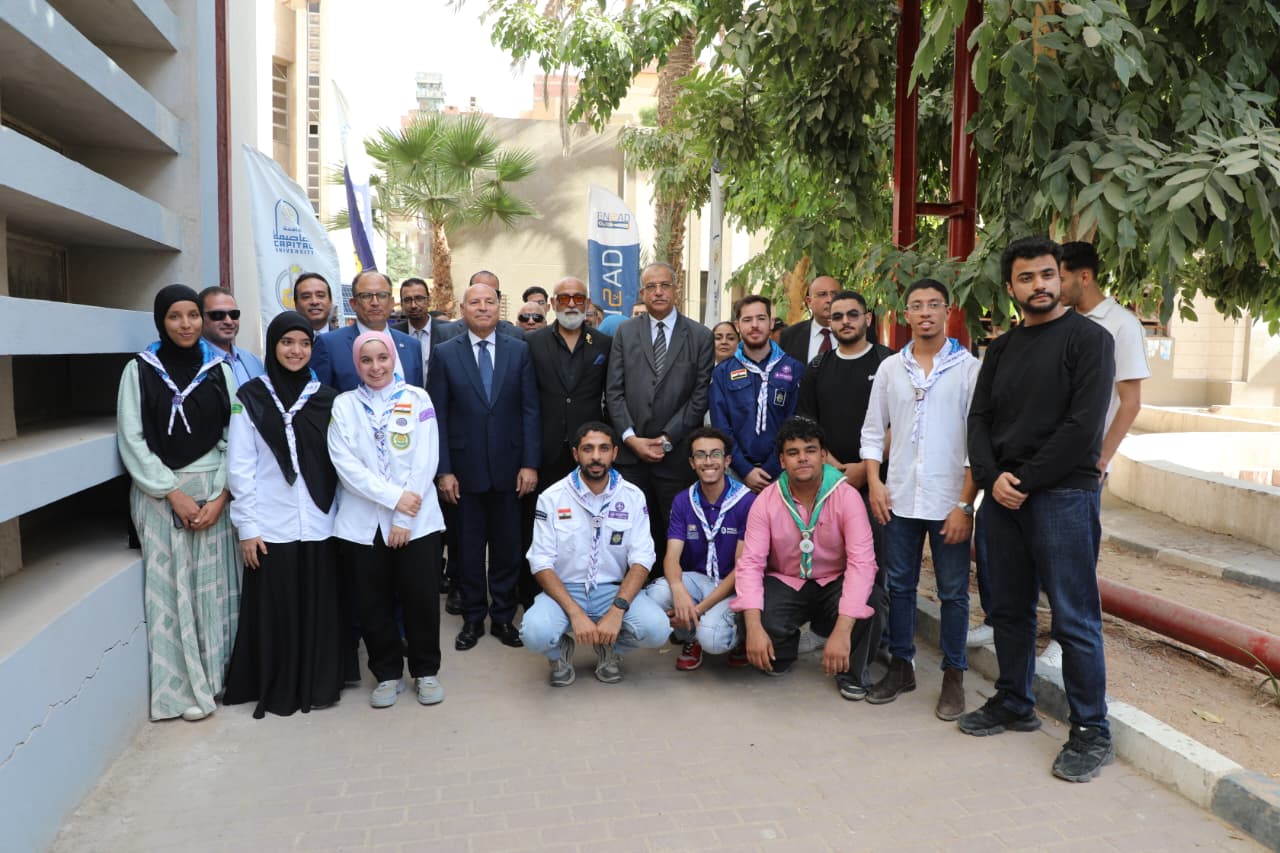
Cairo Governor Dr. Ibrahim Saber and President of Capital University Dr. El-Sayed Kandil inspected several development and technology projects at the Faculty of Engineering in Matareya. They also reviewed plans for upgrading the faculty surrounding area through projects prepared by architectural engineering students.
The governor was accompanied by Mona El-Batrawi, Deputy Cairo Governor; Dr. Amr Abdel Hady, Dean of the Faculty; Dr. Walid Abdel Hady, Vice Dean for Education and Student Affairs; Dr. Noha Nabil, Vice Dean for Graduate Studies and Research; Dr. Mohammad Helmy, Vice Dean for Community Service and Environmental Development; department heads; and Dr. Yasser El-Sayed, Director of the University's Consultancy Center.
The governor began his tour with an inspection of the modern electronic gate system project, which aims to regulate the movement of individuals and vehicles and strengthen campus security. The project is an integrated system that includes electronic gates operated by identification cards for students and staff, surveillance cameras, facial recognition systems, vehicle license plate recognition technology, and software for managing and monitoring entry and exit movements. It also includes maintenance, technical support, and training services to ensure the system operates efficiently and reliably.
The governor and the university’s president also inspected the Hybrid Vehicle Testing Laboratory Development Project, the first of its kind in the Middle East, supervised by Professor Samir El-Demerdash, Professor of Automotive and Tractor Engineering and former Vice President for Education and Student Affairs. The lab is equipped with the latest educational and training equipment in automotive mechatronics and hybrid vehicle technologies. It provides an advanced environment for practical training, technical testing, and applied research. It also contributes to preparing qualified engineering professionals capable of keeping pace with rapid developments in modern automotive technologies and sustainable mobility.
Moreover, the governor and the university’s president reviewed projects presented by the Department of Architecture and Urban Planning and examined students' proposals for developing the university and its surrounding areas. They met several student teams showcasing innovative engineering and technological models that demonstrate the students' ability to apply scientific knowledge to develop practical solutions to contemporary challenges.
During the tour, the governor and the university’s president were introduced to the REHYDRO Project, whose team successfully designed and manufactured a model power-generation station that uses green hydrogen extracted from desalinated seawater. The project relies on solar energy to power the desalination process and produce hydrogen through electrolysis before converting it into electricity using hydrogen fuel cells. The project presents an integrated engineering model that combines renewable energy, water desalination technologies, and green hydrogen production, supporting efforts to localize clean-energy technologies, reduce carbon emissions, and enhance energy sustainability.
The delegation also learned about the ENJAD project, which focuses on designing and developing a five-axis industrial welding robotic arm aimed at automating welding operations while achieving high levels of precision and repeatability. The project combines mechanical design, robotics, control systems, and industrial automation to deliver an innovative engineering solution that supports smart manufacturing applications, improves production efficiency, and opens new opportunities for the deployment of advanced technologies in the industrial sector.
The ENERGETIC team presented its environmental and green-technology project, which seeks to develop integrated engineering solutions combining solar energy, wind power, and energy-storage systems to provide more efficient and reliable energy sources, particularly for agricultural applications and off-grid areas. The project focuses on research and development, prototype manufacturing, and field testing while incorporating entrepreneurship concepts to enhance the prospects of transforming innovative ideas into practical products and solutions.
The delegation also met with the HUM team, which is participating in the international Seismic Design Competition (SDC) in the United States. The team distinguished itself by designing an innovative structural and architectural system for a tower capable of simulating the seismic conditions of earthquakes in Seattle.
As part of the college's comprehensive infrastructure and campus enhancement plan, the delegation reviewed landscaping and open-space beautification work, as well as projects aimed at upgrading buildings and facilities. The tour also highlighted the faculty's self-manufacturing efforts, which demonstrate its ability to leverage its technical and engineering capabilities, develop its own resources, and optimize expenditures.
The delegation further reviewed a development plan for the area surrounding the faculty, prepared by the University's Public Service Center for Engineering and Environmental Consultations. The plan includes a range of proposals and projects designed to improve the urban environment and enhance the area's visual appeal. It also presented an integrated vision for the visual identity of the Ain Shams area, reflecting the faculty's role in applying its academic, engineering, and consulting expertise to serve the surrounding community.
The meeting also explored aspects of cooperation between the university and Cairo governorate in providing engineering and technical consultancy services across various fields. They discussed ways to leverage the university's scientific expertise and consultancy capabilities to support development projects, enhance cooperation between academic institutions and executive authorities, and contribute to realizing development goals and improving surrounding areas.
The tour comes as part of Capital University's vision to further develop the Faculty of Engineering in Matareya as a leading academic and engineering institution that supports innovation and community development. The vision is based on upgrading infrastructure, laboratories, and educational facilities; advancing security and digital transformation systems; and linking engineering education with modern technological applications. It also offers students opportunities to transform their ideas and projects into practical and implementable models. These efforts contribute to preparing graduates capable of meeting labor market demands and participating in building a more sustainable future.
🖋️ Source: Media department, Cairo Governorate