



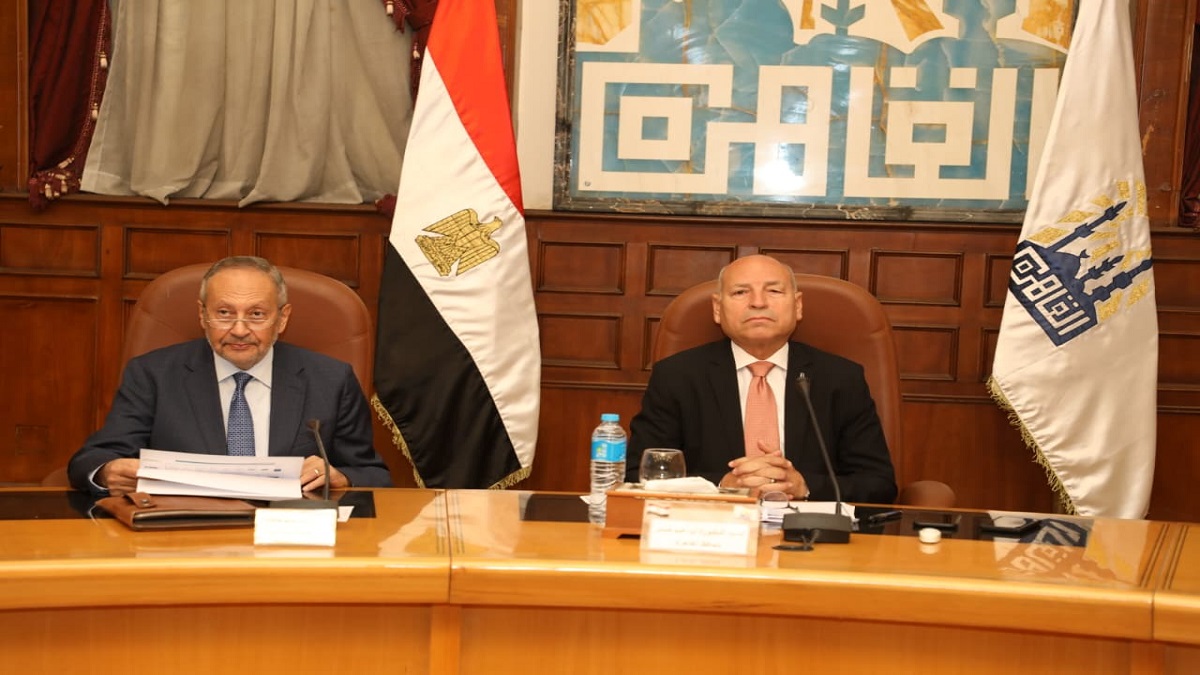
Cairo Governor Dr. Ibrahim Saber witnessed the launch event of the Citizen Services Development Program in the presence of former Minister of Communication Maged Othman. The program is part of the Cairo governorate’s efforts to improve public services delivered to citizens, boost executive performance, improve procedures for addressing citizens’ complaints, and enhance communication efficiency.
The meeting was attended by Deputy Governors Ashraf Mansour, Mona El-Batrawi, Dr. Ahmed Anwar El-Adl, Omar El-Shafei, Brigadier General (Staff) Zaki Atef El-Gayar—the Military Advisor to the Cairo Governorate—district chiefs, and staff from the Citizen Services Centers at the governorate’s headquarters, districts, and directorates.
During the event, Governor Saber said President Abdel Fattah El-Sisi directed the need to improve public services and strengthen performance. He added that the Unified Government Complaints System receives
Saber also stated that true development goes beyond implementing capital development projects and improving living standards; it also involves how to engage with citizens and the capacity to respond to their needs.
The governor further said that the Cairo governorate has been the first to digitize a wide range of services and information relevant to citizens. These digital services include those provided by the Cairo Utility Networks Information Center in Sheraton, educational services, cemetery and parking reservation services, real estate tax services, citizen complaints, building violation reconciliation requests, as well as vacancy announcements, tenders, and auction services. These efforts contribute to simplifying procedures, saving time and effort, and enhancing the efficiency of government performance.
Moreover, the governor said the governorate had previously announced the implementation of the new unified kiosk system throughout Cairo, along with the second phase of the restoration and development project for the Magra El-Oyoun Aqueduct and the Greening Cairo Presidential Initiative. He added that all these efforts come in line with a comprehensive vision to enhance the environment and the capital's urban character.
Governor Saber also said that citizen services centers represent the direct link between citizens and the executive authorities. Through these service centers, citizens form their impressions of the performance of government institutions and their capacity to address citizens' needs and concerns. He added that the responsibility of these centers goes beyond receiving, recording, and responding to complaints. It also extends to understanding the root causes of complaints, tracking the implementation of corrective actions and working to prevent the recurrence of similar issues whenever possible.
Furthermore, Saber said that the development of the complaints system aims to achieve several key objectives, foremost among them speeding up responses to complaints and reducing the time required to process complaints, while ensuring continuous follow-up until a clear resolution is reached. He added that the step also seeks to improve the quality of solutions by addressing the actual problem falling within the jurisdiction of relevant authorities. In addition, it focuses on analyzing recurring problems and utilizing complaints as a tool for identifying shortcomings and their root causes, rather than treating each complaint as an isolated case.
The governor further stated that coordination among relevant entities is vital to ensure well-defined roles and integrated efforts, thereby preventing delays in responding to complaints or being referred from one entity to another without being resolved. These efforts will enhance the citizen experience and promote a culture of engagement based on respect, transparency, and seriousness, while reinforcing citizens' confidence in the executive authorities' ability to respond effectively to their needs and concerns.
The Governor Saber added that the governorate recognizes that improving systems and procedures, regardless of their importance, cannot fully realize their objectives without investing in human capital. He also said that an employee who listens attentively, communicates effectively, and understands the nature and dimensions of a problem is one of the most critical factors in the success of government service delivery. Therefore, the program is designed to improve employees’ skills in effective communication, handling challenging situations, analyzing complaints, and developing practical proposals to boost performance. This will help convert knowledge and expertise into tangible improvements in the workplace.
Cairo Governor Dr. Ibrahim Saber expressed his hope that the outcomes of the program would extend beyond the training period itself and be reflected in speeding up responses, closer follow-up, more effective solutions, and a greater ability to identify problems before they recur and their consequences escalate.
The governor also extended his gratitude to all relevant authorities and team members who contributed to the design and implementation of the program, urging participants to leverage this valuable opportunity to enhance performance and strengthen the government's capacity to serve citizens effectively.
The program is implemented through 6 training workshops over six months, with one workshop per month, aimed at enhancing participants' skills in dealing with citizens, enhancing complaint management efficiency, and upgrading the quality of provided services.
The workshops are based on a participatory education methodology, by dividing participants into working groups, discussing case studies drawn from complaints received by the system, and reviewing the results reached by the groups with the aim of unifying concepts and procedures for addressing citizen complaints at the governorate level.
The program also includes assigning the working groups to prepare development projects at the conclusion of the training, addressing several themes, including human resources development, addressing recurring problems in citizen complaints, developing the services provided at technological centers, and enhancing effective communication with citizens.
The program aims to prepare a unified citizen service guide for Cairo Governorate, a complaint handling quality checklist, and indicators for evaluating the services provided, in addition to developing a plan to improve services and preparing proposed development projects presented by the employees of the Citizen Services Center in the governorate.
Meanwhile, former Communication and Information Technology Minister Dr. Maged Othman and CEO of the Egyptian Center for Public Opinion Research "Baseera" said it is important to develop the government complaints system and digitize services and enhance communication between executive bodies and citizens in a way that contributes to improving government performance, upgrading the quality of services provided, and speeding up response to citizens' complaints. He also urged us to rely on accurate data and analyze it and link performance indicators to real and tangible benefits for citizens in their daily lives.
Dr. Maged Othman also said that digital transformation is not limited to converting paper procedures into digital procedures but rather includes building an integrated information management system that allows the exchange of data between the governorate, districts, and directorates; supports rapid decision-making; and helps track complaints from the moment they are submitted until they are fully addressed, while providing clear indicators on performance rates and the effectiveness of the provided solutions.
🖋️ Source: Media department, Cairo Governorate