



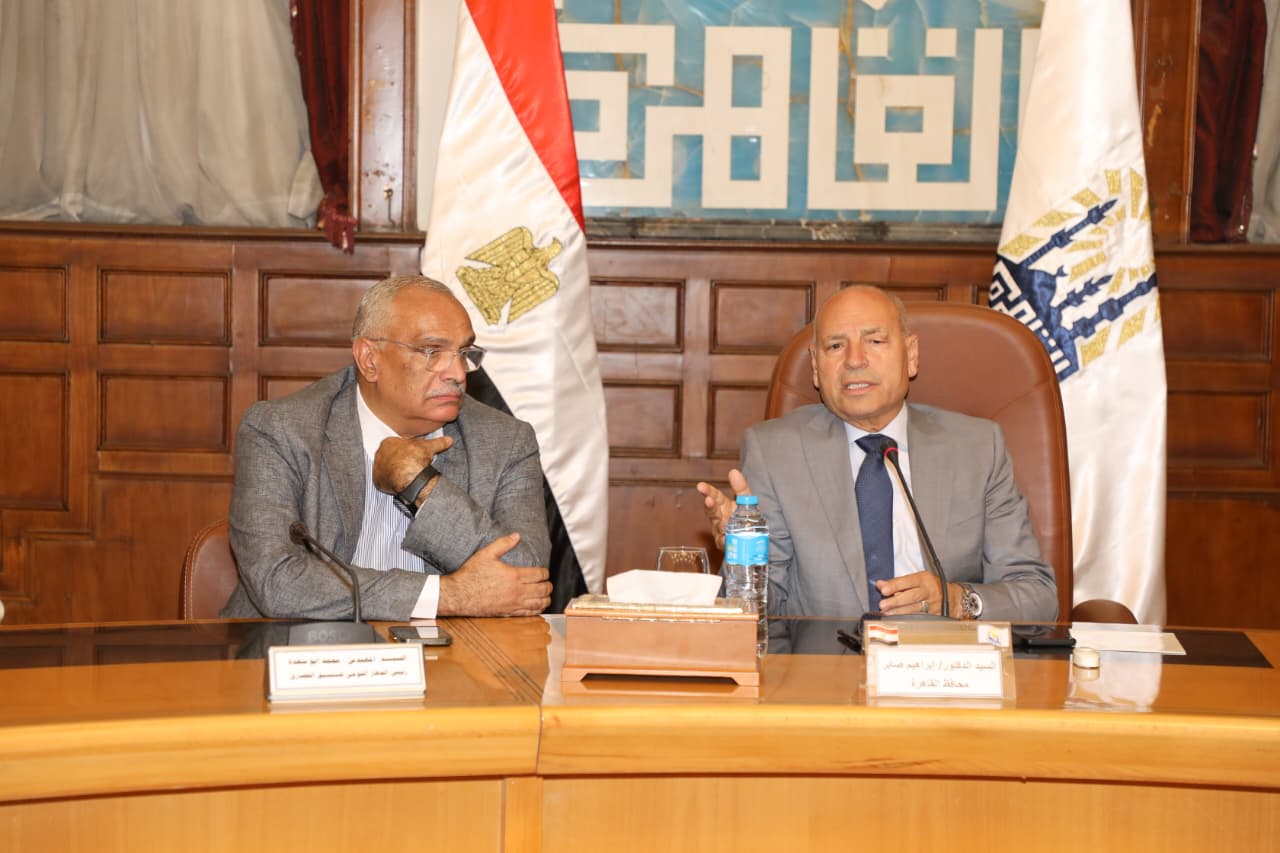
Cairo Governor Dr. Ibrahim Saber held a meeting in the presence of Mohammad Abu Saada, Head of the National Organization for Urban Harmony, and representatives from the Ministry of Antiquities to follow up on the progress of several historic and Khedivial Cairo development projects. These projects are a collaborative effort between the Cairo Governorate and the relevant authorities, within the framework of the state’s efforts to preserve the cultural and historical features of the capital.
The meeting was attended by Deputy Cairo Governor Ashraf Mansour, along with several officials from the Ministry of Tourism and Antiquities, the National Organization for Urban Harmony, and Cairo Governorate.
The meeting addressed the progress of ongoing projects and explored ways to finalize the work according to the highest standards of preserving the archaeological, historical, and architectural value of heritage sites and buildings. The projects aim to regain the glory of historic and Khedivial Cairo and highlight its cultural and civilizational assets.
During the meeting, Governor Saber praised the efforts of the National Organization for Urban Harmony in safeguarding Cairo’s historical heritage and the city’s visual and urban identity. He also commended the Ministry of Antiquities for its support in preserving Cairo’s monuments.
Saber also stressed the significance of maintaining cooperation and coordination among the governorate, the organization, and the ministry to integrate development efforts in historic sites and the preservation of their architectural and urban heritage.
Saber further said that Cairo has an abundance of historic buildings and sites. He added that the governorate is commitment to developing and preserving those sites and buildings in a manner befitting their historical status, while also utilizing them as cultural and tourist attractions. This supports the state’s efforts to turn Cairo into an open-air museum demonstrating its diverse history.
Saber also emphasized that the governorate is focusing on two key axes: keeping pace with modern development while preserving history.
Meanwhile, Dr. Mohammad Abu Saada, Head of the National Organization for Urban Harmony, stated that dealing with historic Cairo requires special sensitivity, as the city has remained vibrant across the ages with its residents, traditions, heritage, and crafts. Its people have never been separated from their historic places, which was one of the reasons for its inclusion on the World Heritage List.
Abu Saada added that the restoration projects of historic Cairo aim to remove elements that distort the heart of the city and eliminate intrusive features.
Source: Media Department, Cairo Governorate